

By the mid-1830s, Return Jonathan Meigs Ward had reached early adulthood and again changed direction. After several years in blacksmith shops under the supervision of relatives, he left that trade for another. By 1835, at twenty, Ward was a tailor.
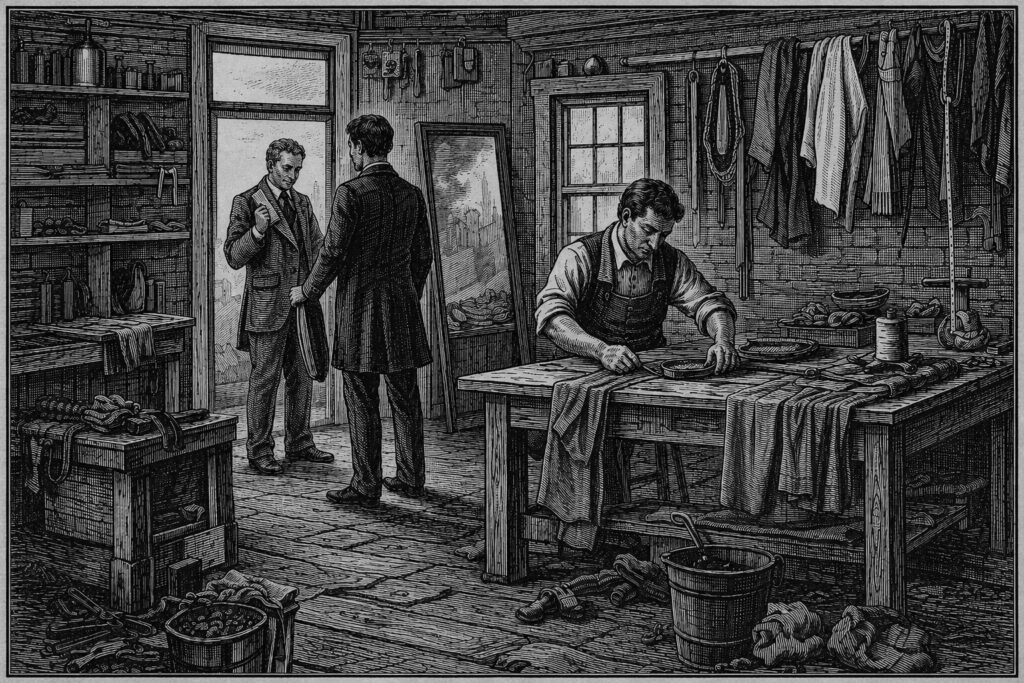
Why he made the change is not entirely clear. One explanation may be physical necessity. Blacksmithing was punishing work, with long hours at the forge, heavy iron, swinging hammers, heat, and strain. Given the lasting effects of the rheumatism that had reportedly distorted his feet in childhood, the trade may have become too hard to sustain. Tailoring was still skilled work that required patience, precision, and training, but it was far less punishing, and much of it could be done seated, which would have suited a body already affected by chronic illness. A simpler explanation is that Ward wanted a different opportunity. Trades in frontier communities were fluid. Men changed occupations when wages shifted, when employers changed, or when a better arrangement appeared elsewhere, and apprenticeship did not always lead to permanence.
Whatever the reason, in 1835 Ward returned to Milan and apprenticed himself to a tailor named Baxter Ashley. Ashley ran a shop on the west side of the town square, serving the growing community along the Huron River. In towns like Milan, tailors held an important place in daily life. Ready-made clothing was uncommon and garments were measured, cut, and sewn by hand. Farmers, merchants, laborers, and tradesmen relied on local craftsmen for coats, trousers, work clothing, and formal wear.
Ward stayed with Ashley for roughly a year. At first the arrangement seems to have offered some stability, but the relationship became strained. Later accounts describe Ashley as devout and morally-minded, and say he tried to steer his apprentice toward a more disciplined and restrained way of living. Ward reportedly did not respond well to that kind of personal guidance. He disliked the influence Ashley tried to exert, and the relationship deteriorated until the apprenticeship ended after about a year.
Ward soon entered the service of another tailor, Patrick Kelly, but the surviving accounts describe him staying only a short time before moving on. A pattern was already visible in his early adulthood. He would work under one employer long enough to learn, earn, or settle temporarily, and then leave in search of something else.
By 1838, Ward had returned to Huron, Ohio, where he went to work for a tailor named Morris Homan. This appears to have been one of the more stable arrangements of his early adult life. He worked under Homan for about three years and his wages reportedly rose with his experience. In his first year he is said to have earned about one dollar per week, modest but typical for a tradesman still learning his craft. Over the next two years his earnings reportedly rose to one hundred dollars per year, which suggests greater skill, greater trust, and more responsibility. Eventually Ward and Homan became partners, which suggests that Ward had progressed beyond hired labor and had gained enough skill and trust to be treated as something close to a business equal.
The stability did not hold. The partnership ended in a disagreement over the division of profits. The surviving accounts do not describe the dispute in full, but such conflicts were common in small frontier businesses, where partnerships were often informal and financial expectations loosely defined. Ward left Homan’s shop and began to move again.
After leaving Huron, he resumed a pattern that would define much of his adult life. Over the following years he moved from settlement to settlement across the developing Great Lakes region, practicing his trade where opportunity appeared. He reportedly worked in Detroit and he appears in several communities in northwest Ohio, including Toledo, Tremainsville, Maumee, and Sylvania. These towns were growing in the late 1830s and early 1840s. The canals were opening to trade, lake commerce was expanding, and the communities along the southern shore of Lake Erie were becoming active commercial centers. For a tailor, that meant demand. Where towns grew and merchants and workers settled, clothing was needed. Ward appears to have moved through this expanding economy, taking work where he could find it.
Some accounts suggest he stayed in Toledo for as long as three years. There he reportedly worked for Snell & Ketchum, a clothing and tailoring establishment on the southeast corner of Summit and Lagrange streets, serving a port town whose population was rising with the lake trade. Even though we know a good deal of where and when he traveled, his exact movements of these years are hard to pin down. Researchers have produced slightly different timelines, the time Ward spent in each town varies by source, and some details overlap while others conflict. One pattern is consistent, thought. He moved often and he rarely seems to have stayed in one place longer than a few years.
Why he moved so often is open to interpretation. One explanation is practical and makes the most sense. Frontier craftsmen often traveled for work, young towns were unstable, businesses opened and failed, and a tailor might stay in one settlement only until demand slowed. Ward may simply have followed opportunity, whether in search of better wages or the promise of a partnership.
Another possibility lies in how later observers described Ward himself. Accounts portray him as difficult. His language was said to be coarse, his temper quick, and his demeanor intimidating. If those descriptions were accurate, they may help explain the instability of his working life. Tailor shops were small and workers spent long hours in close quarters, where disagreements could turn personal quickly. If Ward had the volatility later attributed to him, conflict may have followed him from shop to shop. Some later observers suggested that his frequent moves may have been attempts to leave behind disputes or consequences tied to the places he had worked. No firm evidence confirms this, and it remains speculation.
It is certain that Ward spent much of his early adulr life moving through the towns of the Great Lakes frontier, practicing tailoring where he could. By the standards of the time, he appears to have made a respectable living, since a skilled tailor was useful in any growing settlement. Yet stability never stayed with him for long. Whether he was driven by ambition, practicality, restlessness, conflict, or some mix of these, he continued from town to town, leaving employers, partnerships, and communities.
PREVIOUS >>> The Blacksmith’s Trade
NEXT >>> Troubles Begin

Ward: The Life and Crimes of Ohio’s First Serial Killer, Copyright (c) 2026 Christopher Tillman
All Rights Reserved
No part of this book may be reproduced in any form or by any means without the express written consent of the author and publisher.
All graphics in this book are either images of existing documents, enhanced using A.I. for clarity and readability, or artistic renderings and interpretations of events described in the text.
