

After returning to his father’s farm along the Huron River, Return Ward appears to have stayed at home for roughly a year. The reunion seems to have been cordial, and for a brief period he lived again in a household he had not seen in two years. But as with much of his youth, the arrangement did not last.
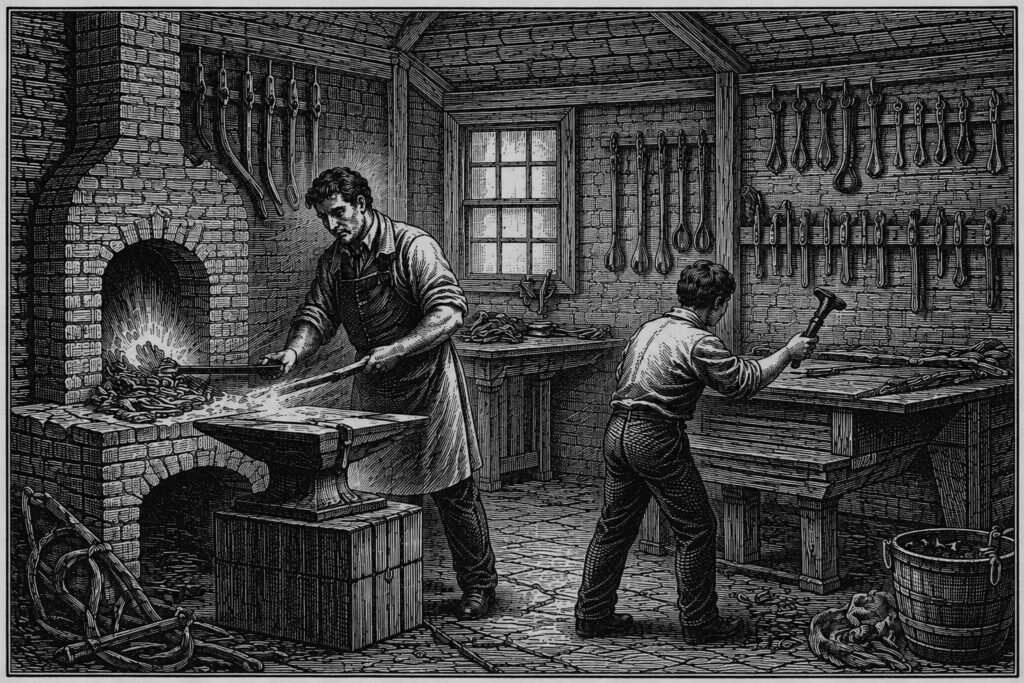
By 1827, when Return was about twelve, his father put him to work again, this time in a blacksmith’s shop. Jared Ward arranged for him to work under a blacksmith named Barney Meeker in the village of Milan. In the early nineteenth century a smithy stood near the center of nearly every frontier community. Farmers depended on blacksmiths for tools, wagon repairs, horseshoes, nails, and the steady supply of ironwork that daily life required. The trade demanded strength, endurance, and skill, and in a growing settlement like Milan, it also offered reliable work.
Boys usually entered the trade as apprentices. Their first duties were simple but not easy. They would have spent much of their time pumping the bellows that fed the forge, carrying heavy iron, hauling coal, and cleaning the shop while they watched experienced craftsmen shape heated metal under hammer and anvil. Those who stayed long enough began to learn the craft itself, heating and bending iron, forging hardware, and making the tools surrounding farms and towns needed.
For Return Ward, the apprenticeship was short-lived.
After only six or seven months in Meeker’s shop, he became seriously ill. Later accounts say he developed a severe case of rheumatism in his feet. In the nineteenth century, “rheumatism” was a broad term for painful inflammatory conditions of the joints and muscles, and without modern treatment such illnesses could become prolonged or permanently damaging. Swelling and pain reportedly made it impossible for him to stand for long periods, which was a serious limitation for work built around heat, weight, and hours at the forge. He was forced to give up the apprenticeship and return to his father’s home. Later histories claim that the bones in his feet became distorted by the disease and left him partly crippled for the rest of his life. If so, the effects would have followed him long after the apprenticeship ended.
In search of relief, Return was sent to stay with a man named Major Hiram Russell, who reportedly lived near the Huron River and suffered from the same affliction. Why Ward was sent there is uncertain, and it is unclear whether Russell was related to the family. Some later researchers have wondered whether he was connected to Asenath Russell, whom Jared Ward married after the death of Return’s mother. If so, that might explain the placement, but the record does not establish the relationship. What appears clearer is that Return suffered considerably during this period.
The illness may also have altered the course of his working life. Most of the labor open to young men on the frontier depended on strength and stamina, and farming, blacksmithing, and maritime work all required long hours on one’s feet. A deformity of the feet could limit what a person could sustain.
Once he had recovered enough to work again, he was moved once more. Return was sent to Columbus, Ohio, to live with Isaac Collins, a blacksmith married to his sister Betsey. Some later accounts call Collins an uncle, but most sources identify him as Ward’s brother-in-law. In Columbus, Ward entered a smithy again and, under Collins’s supervision, resumed the training that had been interrupted in Milan. For someone whose feet had reportedly been permanently weakened, the work cannot have been easy, since blacksmithing meant standing, lifting, and repetition. But it remained one of the most useful and portable trades on the frontier. A trained smith could move between settlements, serve growing towns, and take his skills wherever development followed.
Even here, under his brother-in-law’s care, stability was temporary. Ward was moved to the household of another relative named Stevens, who also ran a blacksmith shop. Later accounts identify him as Zebulon Stevens, the husband of Ward’s sister Sarah, and Ward again learned the trade under family supervision. When Collins later relocated to Huron, Ward remained behind and continued working under Stevens. This arrangement was also brief. Stevens died not long after and Ward moved to Huron, to live with Collins, and resumed apprenticing under him.
This time the arrangement held. Ward stayed with Collins for several years, living and working in his household until he was about nineteen, around 1834. These years appear to have been one of the more stable stretches of his early life, and for perhaps the first time his working life had some consistency.
Still, the pattern of his youth is hard to miss. From an early age, Ward moved repeatedly between households. He went from the schooners of Lake Erie to his father’s farm, to blacksmith shops in Milan, to homes connected through his sisters, then to relatives in Columbus and Huron. Even where family ties existed, the adults who supervised his labor may have been closer to practical guardians than to family in any sense of the word, and he spent much of his adolescence away from his father’s home.
The reasons behind these repeated arrangements remain uncertain. They may simply reflect frontier life. Families often relied on extended relatives to train young men in a trade, provide work, or offer opportunities unavailable at home, and sending a boy to live with a skilled craftsman, even a brother-in-law, would not have been entirely unusual. Whether necessity, opportunity, illness, or family dynamics drove the moves, the pattern remained the same. Ward’s youth was marked by constant movement from house to house.
Illness also left a lasting mark. The rheumatism that reportedly twisted his feet appears to have stayed with him for life, a reminder of the disease that ended his first apprenticeship and may have permanently changed his body. Still, he kept working. Through the late 1820s and into the early 1930s, Return Ward learned the blacksmith’s trade while living among relatives in Columbus and Huron. By nineteen, the young man who had once been a cabin boy on Lake Erie was a trained craftsman.
PREVIOUS >>> Life on the Water
NEXT >>> The Wandering Tailor

Ward: The Life and Crimes of Ohio’s First Serial Killer, Copyright (c) 2026 Christopher Tillman
All Rights Reserved
No part of this book may be reproduced in any form or by any means without the express written consent of the author and publisher.
All graphics in this book are either images of existing documents, enhanced using A.I. for clarity and readability, or artistic renderings and interpretations of events described in the text.
