Long before the name Ward became attached to one of Ohio’s most infamous crimes, the land where Return Jonathan Meigs Ward was born had been shaped by war, displacement, and migration. The region that became Erie and Huron Counties was known in the early years of the republic as the Firelands, a name that came from destruction far away in New England.
During the Revolutionary War, British forces and their American allies raided the Connecticut coast and burned entire towns. The attacks were led in part by the turncoat Benedict Arnold and British General William Tryon. Homes, churches, and businesses were destroyed, and thousands of civilians were left homeless. In 1792, to compensate those who had lost property in the raids, the Connecticut Assembly granted roughly 500,000 acres in the westernmost part of the Connecticut Western Reserve to the victims, who came to be called the “fire-sufferers.” The land they received became known as the Firelands.
The territory covered what are now Erie and Huron Counties, along with portions of what later became Ruggles and Danbury Townships. At the time of the grant, however, it was far from empty. The region had long been home to the Erie people, whose presence is recorded in stone on Kelleys Island. There, on a large limestone slab known as Inscription Rock, generations of Indigenous inhabitants carved pictographs depicting their people and their world. Erosion has worn away much of the detail, but the carvings remain among the most complete collections of Indigenous pictographs in the eastern United States.
By the mid-seventeenth century, the Erie had been driven from the area during conflicts with the Iroquois Confederacy. Other tribes, most notably the Ottawa and the Wyandot, later occupied portions of the land along the southern shore of Lake Erie.
In 1787, Moravian missionaries had arrived at the mouth of the Huron River with Native converts, often referred to in contemporary records as “believing Indians.” They named the place Pettquotting after a distinctive round hill, and a settlement called New Salem soon grew up about two miles north of the site of future Milan. It expanded from 107 inhabitants to 212 within three years, but frontier life was precarious. The threat of renewed conflict between Native tribes forced the missionaries and their followers to abandon the settlement in 1791.
In 1803, the Moravian Church tried again. The missionaries found that Native inhabitants had reoccupied the original site of New Salem, and rather than reclaim it, they moved several miles upriver and founded a new village on land that would become Milan. Thirty-six settlers made the journey together in eight canoes. The Moravians stayed six years. By the time they left, settlers from the older states in the east had begun moving into the area.
The War of 1812 drove some of those pioneers away temporarily, when British warships on Lake Erie made the frontier dangerous. On September 10, 1813, Commodore Oliver Hazard Perry led an American fleet against a British squadron in the Battle of Lake Erie, fought only a few miles from South Bass Island. Perry’s victory secured American control of the lake and reopened the region to settlement and commerce. After the war, migration into the Firelands resumed with renewed intensity.
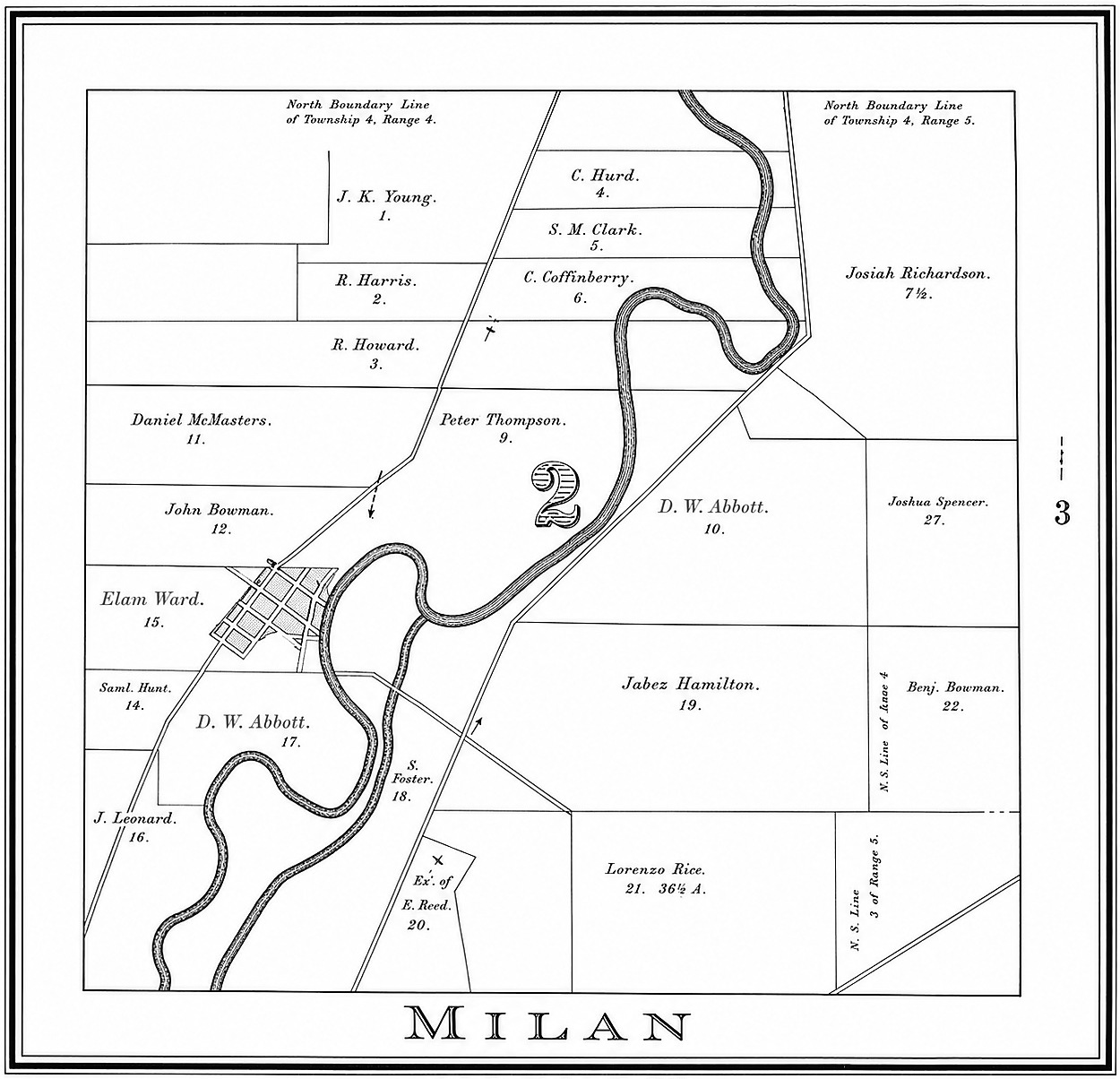
Among the earliest permanent settlers, some of whom arrived before the war, were families from Connecticut and elsewhere in New England. Their names appear in early county histories and pioneer recollections. In what was then Avery Township, later Milan Township, settlers in one section of land included Hosmer Merry, Reuben Pixley, and G. Harvey. In another section were David Abbott, David Barrett, Elijah Pollock, James Leach, Nathaniel Glines, Alexander Mason, A. Collins, and a man named Jared Ward.
One settler’s recollection, published in The Firelands Pioneer in 1859, describes arriving in the area with his father and names Jared Ward among the earliest settlers on the west side of the Huron River. Other settlers soon followed. Jabez Wright arrived that June, and Aimon Ruggles, Simson Hoyt, and Sewell Reese appeared soon after. Most of them, the writer noted, came from Connecticut. Jared Ward settled on land later known as the Hathaway Farm. The writer describes a small cluster of farms strung along the river, with his own father about a mile north of Ward and Wright about a mile farther south.
Conditions were rough. When Jared Ward first established himself, he reportedly lived in an Indian cabin and planted wheat on land he had bought from Abbott. Such arrangements were common in the early years when pioneers used whatever shelter they could find until they could build their own.
The settlers also built the region’s first roads. In 1811, the Ohio Legislature appointed Jared Ward and Jabez Wright as commissioners to survey a state road running south from Lake Erie through the Firelands. The route was surveyed and laid out that year, and by spring the first teams and wagons were using the road from New Lancaster, Ohio. Another road was laid out the same year in the western part of the township by Wright and Charles Barnum. It began on the lake shore west of the Huron River and ran south past the Wright and Ward farms to the home of Charles Parker in what was then the fourth section of Avery Township. From there it continued upriver toward Monroeville and south toward New Haven, along a route not far from that of later roads.
With roads in place, institutions soon followed. According to the same Firelands Pioneer account, the township’s first school was held in an old Indian house standing between two farms, one belonging to the writer’s father and the other to a man named Merry. The teacher was Miss Gilbert, a young woman from Newberg, near Cleveland. Four of Jared Ward’s children attended: Rhoda, Sally, Betsey, and Elam. It is one of the few glimpses we have of the family’s ordinary life.
After the War of 1812, the scattered farms along the Huron began to coalesce into a community. By 1816, the area could support Ebenezer Merry’s grist mill and a small settlement, called Beatty, named for John Beatty, the owner of the surrounding land, grew up around it. Later that year, Merry bought 453 acres from Beatty and divided them into one-acre lots. The new settlement was first called Merry’s Mill and later renamed Milan. One of the earliest houses on the surveyed lots was the David Hinman house, a saltbox built near the end of 1817. It still stands to this day, a rare survivor from the village’s first years.
Milan was not formally incorporated until 1833, but its commercial promise was clear much earlier. The Huron River, flowing north to Lake Erie, offered a natural route for transportation and trade. In 1827, Benjamin N. Abbott, who ran a shipyard just north of a crossing known as Abbott’s Bridge, built a schooner named the Mary Abbott. Loaded with produce from surrounding farms, she sailed down the Huron into Lake Erie and east to New York City, where the cargo was sold, and returned to Milan with goods for the settlement.
This was the world into which Return Jonathan Meigs Ward was born on June 8, 1815, in Erie County, Ohio.
His unusual name was almost certainly chosen in honor of Return Jonathan Meigs, who served as governor of Ohio in the early nineteenth century. Meigs also gave his name to Fort Meigs in Perrysburg, a site closely associated with the War of 1812 and the defense of the frontier along the Maumee River.
Return Ward was born into a family that appears to have held a good deal of standing among the early settlers of the Firelands, and it remained tied to the land for generations. Jared Ward lived into his nineties and spent his later years with his son Elam on the family farm. Some accounts suggest he may still have been alive when Return was hanged, though the record is not clear on the point. Elam remained on the farm after his father’s death and lived there until he died in 1888 at the age of eighty-four. He married several times, first to Christian Bayard and later to Jane Merry, who died in 1891. Jared, Elam, and Elam’s wives are buried together in Sweet Cemetery in Erie County, near the family farm.
Other members of the family scattered across northern Ohio and beyond. Huldah Ward, Return’s mother, died in 1817 and was likely buried in the cemetery behind the old county seat. Rhoda Ward married Eli Hubbard and died in Sylvania, Ohio, in 1840. Sarah, often called Sally, married Zebulon Stevens and, after his death, moved to Peru in Huron County, where she died in 1842. Collins Ward married Laura Thomas and lived until 1886. Betsey Ward married Isaac Collins, and the couple moved to Huron in 1858, the year after Return was hanged. Some accounts suggest the move was meant to escape the notoriety that had attached itself to the family name, though that remains speculative.
But none of that future was visible yet in 1815. Milan was still a young village, the farms were still being cleared, and the roads had only recently been cut through the forest. It was in this frontier world, along the fields and riverbanks of the Firelands, that the life of Return Jonathan Meigs Ward began.
PREVIOUS >>> Introduction
NEXT >>> Childhood Lost

Ward: The Life and Crimes of Ohio’s First Serial Killer, Copyright (c) 2026 Christopher Tillman
All Rights Reserved
No part of this book may be reproduced in any form or by any means without the express written consent of the author and publisher.
All graphics in this book are either images of existing documents, enhanced using A.I. for clarity and readability, or artistic renderings and interpretations of events described in the text.
