

Olive Bickford, later Olive Davis, was born in New York in 1824. Compared with the extensive documentation of Return Ward’s life and crimes, little is known about her early life. What fragments survive suggest a modest, working-class background. Her father, we believe, was a carpenter and her family likely lived on the steady labor of skilled manual work.
By 1850, Olive appears in the federal census in Madison Township, Lenawee County, Michigan, at twenty-five, listed in the household of a man named Joseph Davis, then twenty-seven. Also in the home was an infant named Frank Davis, believed to have been only a few months old when the census was taken. Researchers have interpreted the household in different ways, but the entry indicates that Olive was married to Frank at the time.
Sometime in the following years, the marriage ended. By the mid-1850s, Olive was living in Adrian, Michigan, separated or divorced from her husband and supporting herself while raising two young children, a boy and a girl. Later writers describe her as running a boarding house in Adrian, which suggests she had taken on the demanding work of a household business while caring for her family. During the same period, Return Jonathan Meigs Ward was living in Sylvania, Ohio.
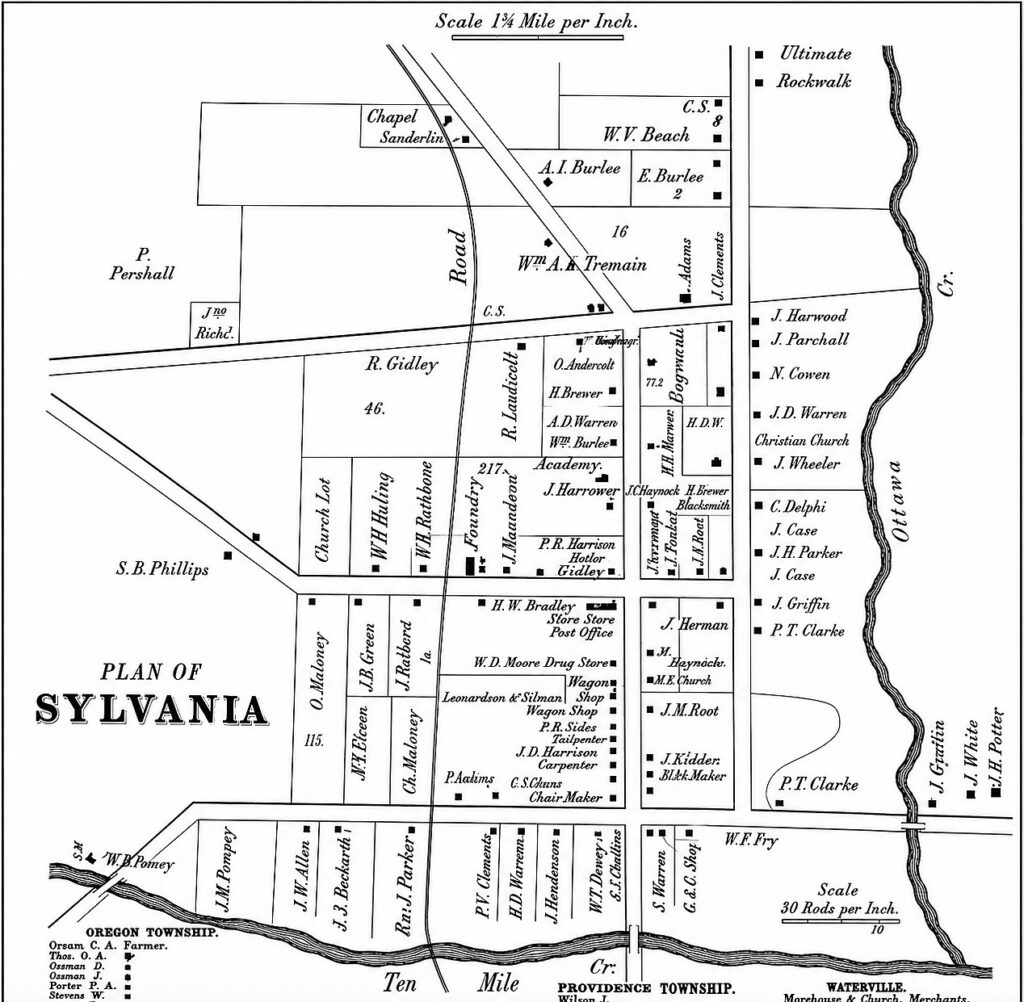
By then Ward had left a troubled path behind him. The money from the robberies and murders in Planktown had long since been spent. His brief marriage to Susan Reese had ended with her death, and he was alone again. He occupied a small house in Sylvania’s modest downtown, a settlement that consisted largely of a single street lined with plain wooden buildings, homes, and small shops, and the usual establishments of a frontier town, a grocery, a blacksmith shop, a livery stable, and a saloon. Ward supported himself by tailoring, running his shop out of his home.
His solitude did not last. Within roughly eight months of Susan’s death, Ward became acquainted with Olive Davis of Adrian. Some accounts say the introduction may have been arranged through Olive’s brother. If so, it suggests that someone considered Ward a suitable husband despite the instability in much of his life. Whatever the circumstances, the new romance moved with remarkable speed. According to contemporary sources, Ward and Olive knew each other for only two or three days before they were married.
The marriage took place in the fall of 1856. Some researchers have speculated that the union was shaped by practicality as much as affection. Olive, a divorced or separated mother of two, may have hoped to secure stability for her family, and Ward, living alone and rebuilding his life, may have found domestic companionship equally useful. Whether true affection played any part is impossible to know.
After the ceremony, the couple traveled to Sylvania, where they stayed about two weeks at a hotel run by a man named L. Parker. The hotel’s exact location is still a bit uncertain, though it probably stood along the main street where travelers and residents lodged. After that, Ward and his new wife rented a small house on Division Street. It was a one-story structure reportedly measuring only sixteen by twenty feet, cramped for a family of four.
Soon after they settled in, Ward gave Olive ten dollars so that she could go back to Adrian and bring her children to live with them. She was gone about three days and returned with her eight-year-old son and three-year-old daughter.
At first Olive seems to have adapted quickly. Later accounts describe her as amiable and personable, someone who made friends easily and often visited the homes of neighbors and acquaintances. In a town where she had few ties, these visits may have given her companionship and support.
Inside the house on Division Street, though, the marriage was already under strain.
Ward reportedly developed a strong dislike for the children almost at once. According to several accounts, their presence became a constant irritation to him, whether from resentment, impatience, domestic stress, or hostility toward stepchildren, and arguments between him and Olive became frequent and heated. Olive objected strongly to how he treated her children. Some historians describe his behavior as openly cruel, while other researchers more cautiously label Ward as harsh or unkind. Whatever its exact nature of his relationship to Olive’s children, it caused growing tension in the home.
At one point Olive reportedly told Ward that her former husband wanted custody of the children. Ward suggested she should let him have them. That response angered Olive and she insisted her former husband would never be allowed to take them back. Eventually, the household reached a breaking point and the children were sent away. After about three weeks, Olive arranged for her son to live with George Davis, a brother of her former husband, and her daughter was sent to stay with a woman named Mrs. Haley, who had once lived in Sylvania but had moved to Ottawa Lake, Michigan. Some later accounts say Olive made this decision because of Ward’s continued cruelty toward the children and because she feared for their safety. That cannot be confirmed, but it appears often enough in later sources to be worth noting. The girl returned briefly to the house on Division Street but was soon sent back to Mrs. Haley.
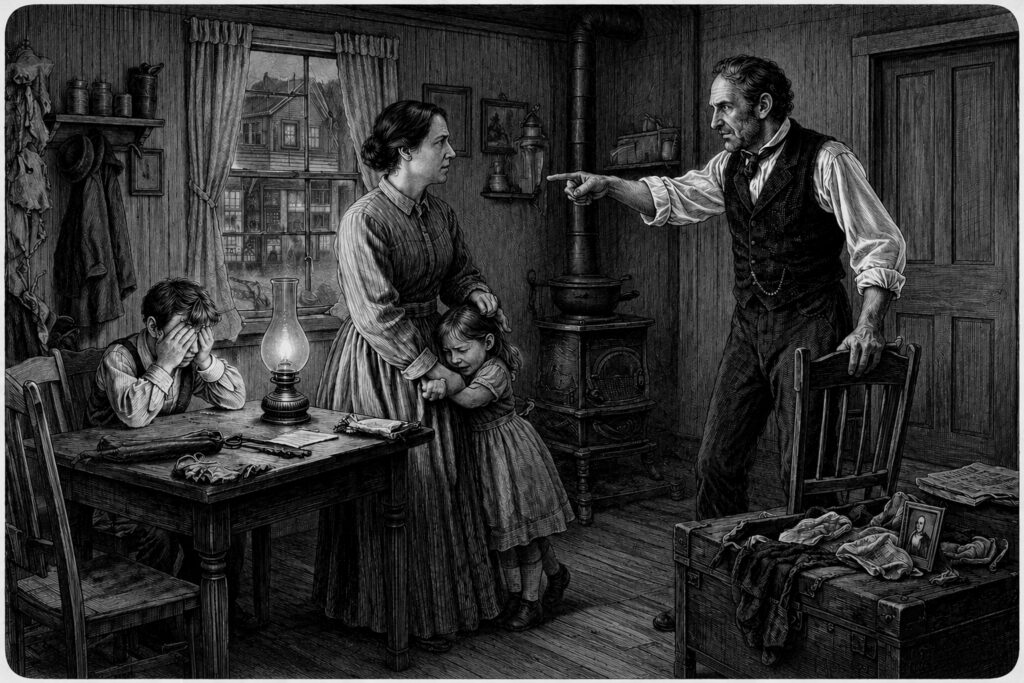
With the children gone, the small house held only Ward and Olive, but the marriage did not improve. Neighbors reportedly heard frequent arguments coming through the walls of their small house. Several accounts describe the marriage as deeply unhappy, with Ward’s temper, which had caused trouble throughout his adult life, surfacing again in repeated quarrels. Olive is said to have begun confiding in friends and neighbors that she no longer felt safe in her own home. According to some reports, Ward threatened her with a dagger, and one account claims he warned that if she did not “look out,” it might cost her her life. These claims cannot be verified. They survive mostly through accounts of those she confided in rather than Olive’s own direct testimony, but they reflect the fear she was said to have expressed, and they suggest that those around her may have known something in the household had gone badly wrong.
Some writers have noted an uncomfortable parallel between Ward’s treatment of Olive’s children and his own childhood. As a boy, Ward had been sent away from home after his mother’s death and raised for a time among relatives and near-strangers. Whether that experience shaped his hostility toward children cannot be determined. The resemblance is just an observation, not a conclusion.
By late 1856, the house on Division Street was a place of constant quarrels and growing fear. Within months, the marriage between Return Ward and Olive Davis would end with her murder.
PREVIOUS >>> A New Life in Shelby
NEXT >>> Olive Leaves

Ward: The Life and Crimes of Ohio’s First Serial Killer, Copyright (c) 2026 Christopher Tillman
All Rights Reserved
No part of this book may be reproduced in any form or by any means without the express written consent of the author and publisher.
All graphics in this book are either images of existing documents, enhanced using A.I. for clarity and readability, or artistic renderings and interpretations of events described in the text.
