

By the mid-1820s, Return Ward had begun to move into the working world of the Great Lakes. Much of his early childhood is hard to reconstruct, but we do know that by about 1824 or 1825, when he was nine or ten, he appears to have entered a very different life from the one most frontier children knew. He found work aboard a Lake Erie schooner.
He served as cabin boy and cook on a vessel called the Dread, under a captain named Nichols. On Great Lakes ships of the period, cabin boys did whatever was needed to keep a small crew running. They cooked, cleaned cramped quarters, fetched supplies, and helped the sailors with routine labor. It would have been hard work for a child, but it was not an unusual practice. Shipping had become one of the major industries on the southern shore of Lake Erie, with schooners carrying grain, lumber, produce, and other goods between Ohio ports and commercial centers farther east. The ships needed labor and boys were often placed at the bottom of the crew.
Later writers have pointed to Ward’s time aboard the Dread as evidence of neglect or abandonment, picturing a boy pushed aside and sent away to work far from home. The surviving record does not clearly support that interpretation. Frontier life demanded early work. Formal schooling was limited, children were expected to contribute to the family, and many entered trades through informal apprenticeships or labor arrangements that mixed necessity with opportunity. Service aboard a ship could provide both income and skill. Lake commerce was expanding and Jared Ward, an established figure in the Milan area, may have seen the work as a chance for his son beyond the farm. Whether that was his reason is unclear. What appears certain is that Return spent at least one shipping season aboard the schooner.
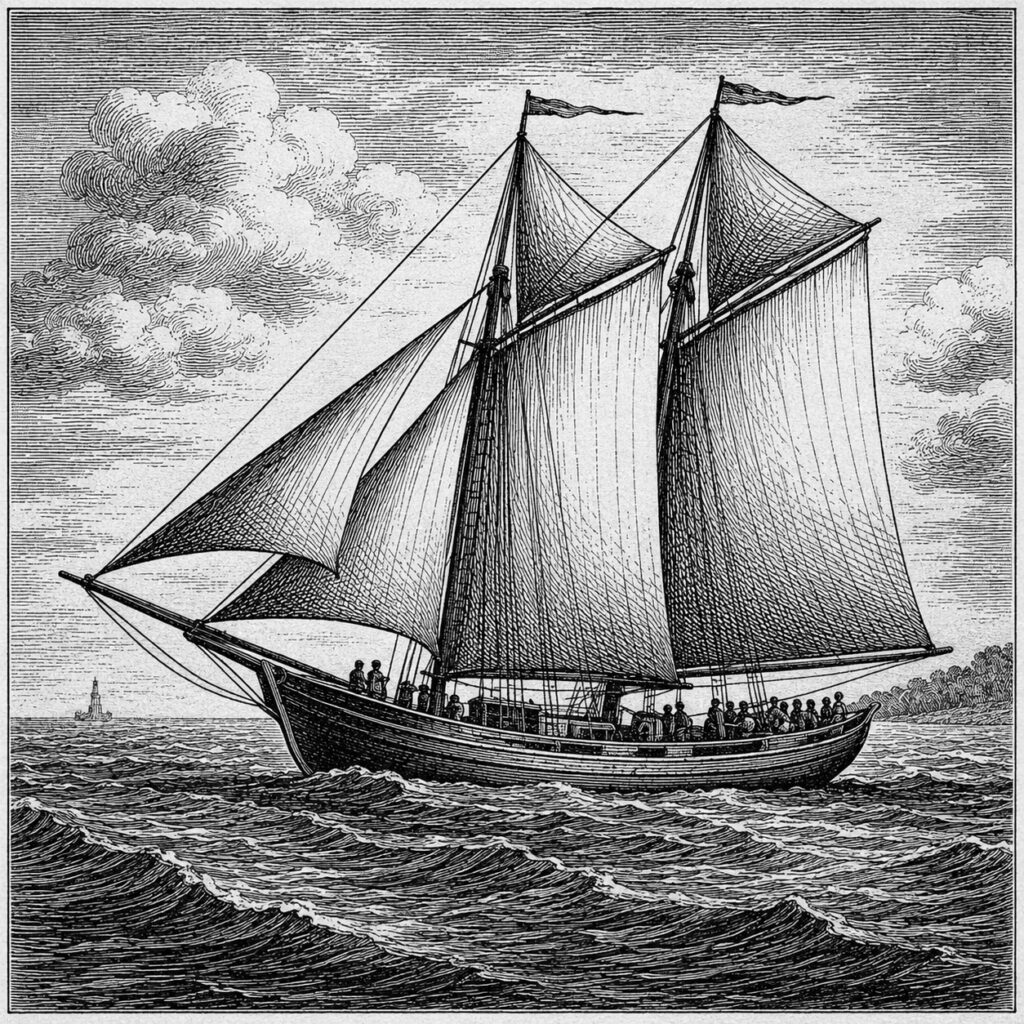
Life on a Great Lakes vessel in the 1820s was rarely easy. Crews were small and quarters were tight, and the work did not stop for fatigue or weather. Even experienced sailors endured long hours in shallow harbors, changing winds, and shifting inland waters. For a young cabin boy, it demanded discipline and endurance. It may also have shown him a wider world. For a boy raised along the Huron River, voyages on a schooner like the Dread meant harbors, shoreline towns, unfamiliar crews, and the commercial traffic that linked communities around Lake Erie, each trip carrying him farther from farm life.
But this job did not last. At the end of the shipping season, the Dread was sold and its crew dispersed. According to later accounts, the young cabin boy was left stranded among strangers when the ship changed hands. Where this happened is uncertain. Some sources say Erie, Pennsylvania, and others say Erie County, Ohio. The outcome, though, appears the same. The boy was suddenly out of work and away from home. For an eleven-year-old, that was a precarious position.
Local families reportedly took him in for two or three weeks after boys his own age befriended him, and he depended on the generosity of people who owed him nothing beyond sympathy. Eventually he found passage aboard another vessel, commanded by a lake captain named Green. He reportedly spent several months in the captain’s care while working his way back toward the Huron River. How the arrangement began is unclear. The captain may simply have taken pity on a stranded boy or Ward may have kept doing the shipboard work he had learned on the Dread. The record does not say.
One later account describes the reunion with his father as almost accidental. While staying near the Huron River, Ward reportedly noticed a canoe on the water that looked familiar and recognized it as one of his father’s. He approached the man paddling it and began talking, and learned that his father was living several miles upriver. The man agreed to take him along and, together, they traveled five or six miles to Jared Ward’s home. Return was eleven. According to the same accounts, he had not seen his father or any relative in two years. He was reportedly received kindly and allowed to stay, and he remained with his family for about a year.
That reunion complicates the somewhat common belief he had been abandoned. Jared appears to have welcomed his son back without resistance, which suggests the earlier separation may have been an apprenticeship, a labor arrangement, or some other practical decision of frontier life rather than an exile. Large parts of Ward’s early life are undocumented, and the years between his mother’s death in 1817 and his appearance aboard the Dread are barely illuminated by the record. Later writers have filled that silence with stories of hardship, wandering, and neglect, and many have read his childhood backward through the violence of his later life. The surviving evidence offers only fragments.
What we do know is that, by the age of eleven, Return Ward had worked aboard a Great Lakes schooner among sailors, been stranded among strangers, made his way along the waterways of northern Ohio toward his family, and returned to the farm beside the Huron River and to a father he had not seen in two years.
PREVIOUS >>> Childhood Lost
NEXT >>> The Blacksmith’s Trade

Ward: The Life and Crimes of Ohio’s First Serial Killer, Copyright (c) 2026 Christopher Tillman
All Rights Reserved
No part of this book may be reproduced in any form or by any means without the express written consent of the author and publisher.
All graphics in this book are either images of existing documents, enhanced using A.I. for clarity and readability, or artistic renderings and interpretations of events described in the text.
