
After leaving Cass Township under suspicion of arson, Return Jonathan Meigs Ward and his wife Sarah relocated to New Haven in Huron County. For a time their lives appear to have settled into something quieter. Ward resumed his work, and for several years the surviving record shows little sign that the legal troubles and disputes of his earlier years continued with the same intensity. How stable those years were is harder to say. The record gives only brief glimpses of the period and leaves most of the couple’s daily life undocumented. What can be said is that Ward lived in Huron County for several years without again drawing the attention of the courts, which, for a man whose adult life, so far, had been marked by conflict, accusations, and abrupt departures, stands out.
However stable his life may have been at this point, it did not last. In 1847, Ward received an offer that would again change the direction of his life. He was invited to take over a public boarding house in Cass Township, back in Richland County, the region he had left only a few years earlier. Whatever hesitation he felt about returning to a place where suspicion had followed him, the offer was enough to draw him back. The establishment was called the Eagle House, sometimes called the Eagle Tavern in some historical accounts. Ward accepted, and he and Sarah returned to Richland County.
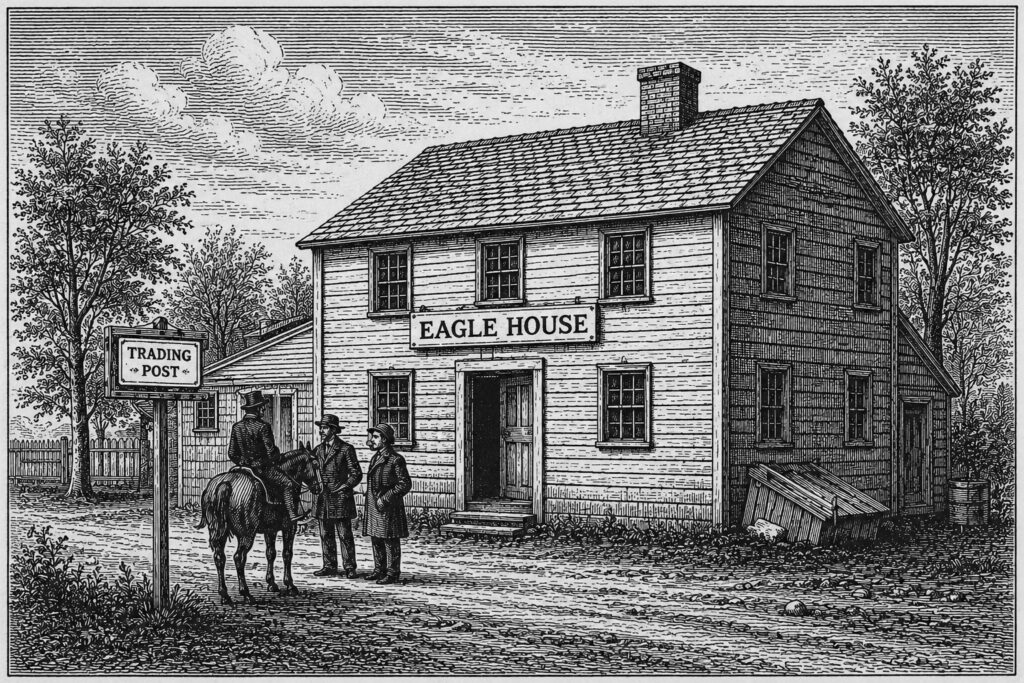
The Eagle House stood in a small frontier village officially called Richland, though most people knew it by another name: Planktown.
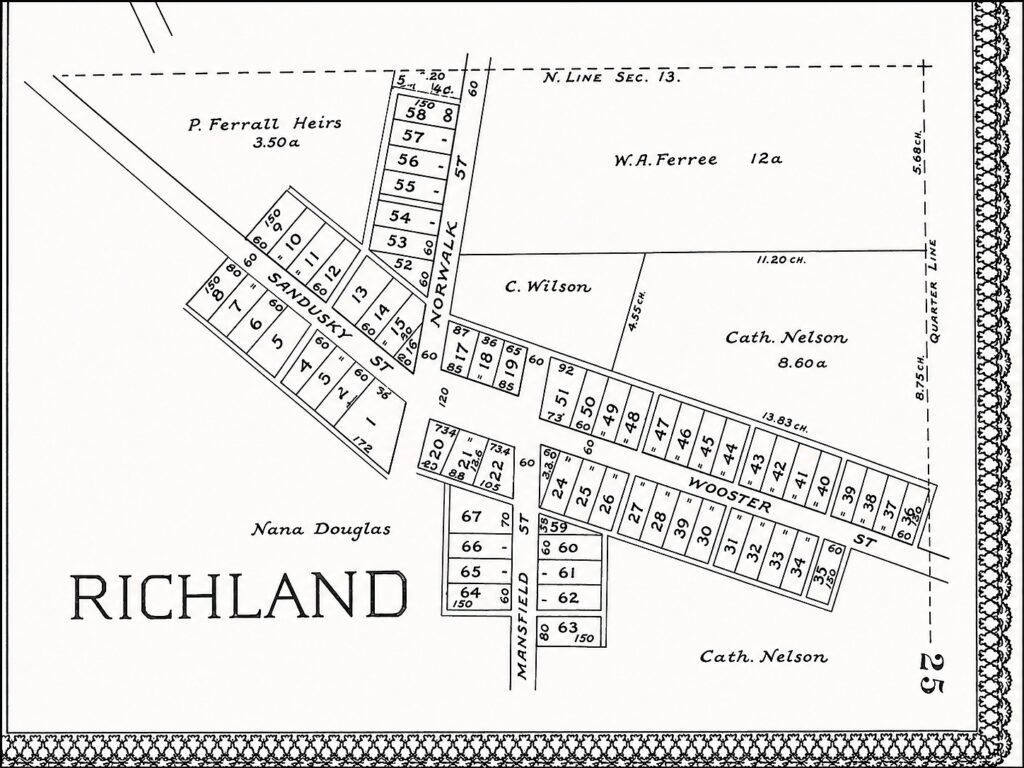
The nickname came from John Plank, who is credited with laying out the settlement. Historical accounts say he first named the village Plymouth and later changed it to Richland, but residents kept calling it Planktown, and the name stuck. Like many frontier settlements, Planktown had grown quickly. At its height it had roughly two hundred people, two general stores serving the surrounding farms, and two hotels or taverns offering lodging, meals, and space for travelers and residents alike. It sat along developing roads that connected interior Ohio with neighboring settlements, which made it a natural stopping place for merchants, laborers, and wagon traffic.
Growth also brought roughness. Later historians described Planktown as a hard frontier place that attracted men trying to escape scrutiny in more established communities, among them gamblers, drifters, petty criminals, and others who kept moving in order to stay ahead of the law. One later account described places like Planktown as communities where “roughs” gathered, including thieves, gamblers, and men with reason to keep moving westward or to remain unsettled on the frontier. According to that description, the town became “more than usually infested” with such characters, which later writers believed contributed to its ultimate decline.
It was into this environment that Ward brought his new enterprise. The Eagle House stood at the northeast corner of Wooster and Norwalk Streets. As a public boarding house it served several purposes at once. Travelers could stop for food, drink, and a bed for the night, and laborers, merchants, or tradesmen might stay longer as permanent boarders. Taverns and boarding houses were also gathering places where news circulated, business was arranged, and much of community life played out through conversation and rumor. For Ward this was more than another job. It was a more visible role, since a tavern keeper stood near the center of local life.
When he first took control of the Eagle House, his resources appear to have been limited. According to a later statement attributed to Ward himself, his entire inventory was a single table, three beds, a little flour, a few potatoes, and two gallons of whiskey. It was not much, but it was enough to begin. Gradually, conditions improved. He added furniture, expanded the accommodations, and increased the tavern’s capacity to serve both travelers and long-term boarders. That was typical of frontier boarding houses, where steady income often depended on balancing transient visitors with local residents who paid regularly for meals and lodging.
By 1850, Ward appears to have been firmly established. The federal census lists him in District 27 of Cass Township living with his wife Sarah, his occupation recorded as “tavern keeper.” The Eagle House seems to have operated successfully for several years, with Ward managing it and serving both Planktown residents and those passing through. For a man who had spent much of his adult life moving between towns, changing trades, and leaving partnerships, this appears to have been one of the more stable business arrangements of his life.
But even here, conflict did not entirely disappear. In 1849, an incident arose involving a man named Thomas Tumelson. Ward brought charges against Tumelson, claiming the man had attacked him with intent to kill. The details of the altercation are not well preserved, and the record says little about what led to it. The matter went to court, where Tumelson appeared and pleaded guilty. He was ordered to pay restitution of two thousand dollars, an enormous sum for the time. The case illustrates how quickly disputes in frontier communities could turn into legal conflict. Whether Ward was the clear victim of an attempted attack, or whether the circumstances were more complicated than the record shows, is difficult to know.
What we know for sure is that, by the late 1840s, Ward held a far more prominent place in Planktown than he had in many earlier communities. The Eagle House was one of the town’s central establishments. Residents gathered there, travelers came and went, business was discussed, and rumor and news passed through its doors. For a man whose earlier life had been defined by wandering labor, unstable partnerships, and repeated moves, becoming a proprietor put him at the center of community life in a way few earlier occupations had. It also put him in a rough and unpredictable frontier setting.
In the years that followed, events inside the Eagle House would make both the establishment and its proprietor part of regional history for reasons far darker than ordinary tavern business.
PREVIOUS >>> Trouble Follows
NEXT >>> The Murder of Noah Hall

Ward: The Life and Crimes of Ohio’s First Serial Killer, Copyright (c) 2026 Christopher Tillman
All Rights Reserved
No part of this book may be reproduced in any form or by any means without the express written consent of the author and publisher.
All graphics in this book are either images of existing documents, enhanced using A.I. for clarity and readability, or artistic renderings and interpretations of events described in the text.
